
Understanding how organic date powder is different from date syrup is essential for anyone looking to replace refined white sugars with a wholesome, whole-food alternative. While both sweeteners originate from the exact same nutrient-dense fruit, their distinct manufacturing processes result in completely different physical properties, nutritional profiles, and culinary applications.
If you are a food manufacturer, baker, or health-conscious consumer in the EU looking to upgrade your ingredient supply, you can buy wholesale oganic date powder and premium syrups directly from Sahara Food EU. Choosing between the two isn’t a matter of which sweetener is objectively better, but rather which texture, moisture level, and flavor concentration fits your specific recipe goals.
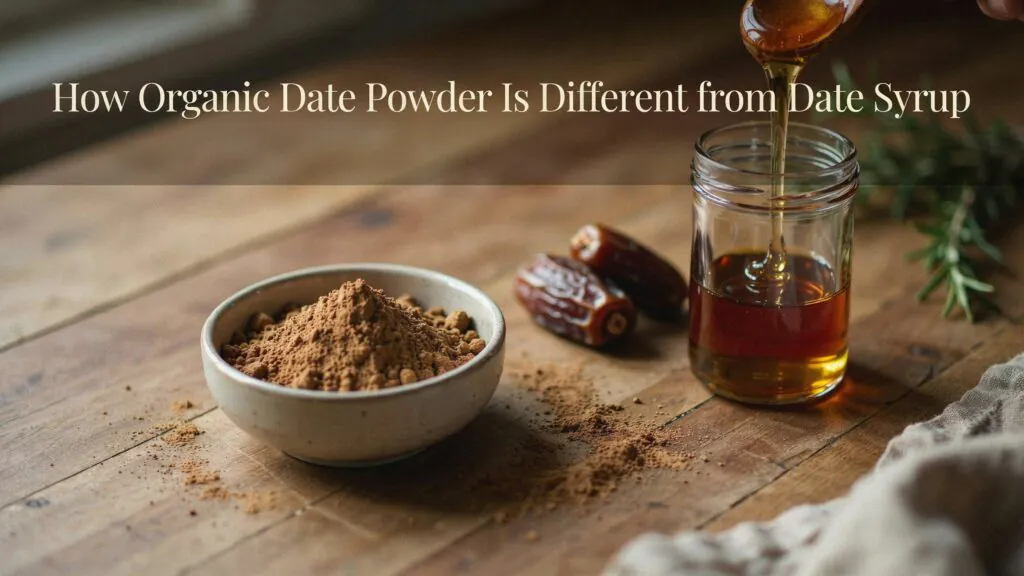
The Core Difference: Dehydrated Whole Fruit vs. Extracted Liquid
To understand how these two sweeteners behave in the kitchen, you have to look at how they are made. They sit at opposite ends of the processing spectrum when it comes to moisture control.
What is Organic Date Powder?
Organic date powder (sometimes called date sugar) is not actually a soluble sugar in the traditional sense. It is made by taking 100% organic dates, dehydrating them completely until all moisture is gone, and then milling them into a fine, free-flowing flour. Because it is simply ground-up whole fruit, it retains every single bit of the original date’s dietary fiber, vitamins, and minerals.
What is Organic Date Syrup?
Organic date syrup (also known as date molasses or Silan) is a rich, dark liquid sweetener. It is produced by boiling organic dates in water, blending them into a slurry, and then filtering out the heavy insoluble pulp and fiber. The remaining sweet liquid is then gently concentrated through evaporation until it reaches a thick, velvety consistency similar to maple syrup or honey.
Nutrition and Fiber: The Structural Divide
Because date powder keeps the whole fruit intact while date syrup filters out the pulp, their nutritional behavior in the human body varies slightly.
The Fiber Factor
-
Date Powder: Since it contains the entire fruit, date powder is exceptionally high in dietary fiber. This fiber acts as a natural speed bump for your metabolism, slowing down the absorption of sugars into your bloodstream and providing a more sustained release of energy.
-
Date Syrup: While date syrup retains an incredible concentration of soluble minerals and vitamins, the vast majority of its structural, insoluble fiber is removed during the filtration process. As a result, it has a slightly quicker digestion rate than the powder, though it still boasts a lower glycemic index than highly refined white sugar or corn syrup.
Vitamin and Mineral Retention
Both options are incredibly rich in essential minerals compared to empty-calorie white sugars. They serve as excellent sources of potassium, magnesium, iron, and antioxidants. However, because date powder is completely unheated and unfiltered, it preserves raw heat-sensitive nutrients slightly better than cooked syrups.
Culinary Application: When to Use Powder vs. Syrup
The physical state of your sweetener changes how it interacts with fats, liquids, and leaveners in a recipe. Using the wrong one can easily ruin the texture of a baked good or dessert.
When to Choose Organic Date Powder
Date powder excels in dry mixtures or recipes where adding extra liquid would compromise the structure of the final product.
-
Baking 1:1 Substitutions: It can often be substituted for brown sugar or white sugar on a 1:1 basis in rustic bakes like cookies, muffins, crumble toppings, and banana breads.
-
Dry Rubs and Coatings: It works beautifully as a sweet component in spice rubs for proteins, or sprinkled directly over oatmeal, chia puddings, and yogurt bowls.
-
The Solubility Catch: Because it is made of ground fiber, date powder does not dissolve perfectly in liquids. If you stir a spoonful into your hot coffee or tea, you will notice a fine, fibrous sediment at the bottom of your cup.
When to Choose Organic Date Powder’s Liquid Counterpart: Date Syrup
Date syrup is your go-to option when you need seamless blending, moisture retention, or a gorgeous glaze.
-
Perfect Dissolvability: Because it is already a liquid extract, it dissolves instantly into hot and cold beverages, making it the perfect choice for lattes, iced coffees, and cocktails.
-
Sauces and Dressings: It whisks effortlessly into vinaigrettes, marinades, BBQ sauces, and raw vegan desserts.
-
Moisture and Bind: Date syrup adds a beautiful, chewy moisture to homemade granola bars, flapjacks, and raw energy bites, acting as a natural binder where a dry powder would leave the mixture crumbly.
Shelf Life and Storage Realities
The presence or absence of water completely dictates how you must store these two organic products in your pantry or commercial kitchen.
-
Date Powder is Hydrophobic: Because it is completely dehydrated, date powder loves to absorb moisture from the air. If left open in a humid room, it will quickly clump together into a hard block. It must always be kept in an airtight container in a cool, dry place.
-
Date Syrup is Stable but Thick: Date syrup has a naturally long shelf life due to its high sugar concentration and reduced water activity. It does not need to be refrigerated after opening, though storing it in a cool spot will prevent flavor degradation over time.
The Verdict for Sahara Food EU Customers
When choosing between organic date powder and date syrup, simply ask yourself: Does my recipe need moisture and smooth blending, or does it need dry bulk and fiber?
For baking structures that resemble traditional brown sugar textures, go with the powder. For pourable sweetness, marinades, and effortless mixing, reach for the syrup. By keeping both staples on hand, your kitchen is fully equipped to tackle any healthy, organic creation without ever touching a bag of refined white sugar.