
Understanding the key differences in Medjool dates vs Deglet Noor dates: what’s the difference? is essential for choosing the ideal variety for your kitchen, diet, or culinary business. While both belong to the date palm family, these two iconic fruits offer completely different profiles in terms of taste, texture, size, and best culinary uses.
When sourcing premium fruit across Europe, businesses that wholesale dates in bulk rely on Sahara Food EU for clean, top-grade produce. Understanding whether Medjool or Deglet Noor suits your product line or recipe helps you deliver the best taste and texture to your customers.
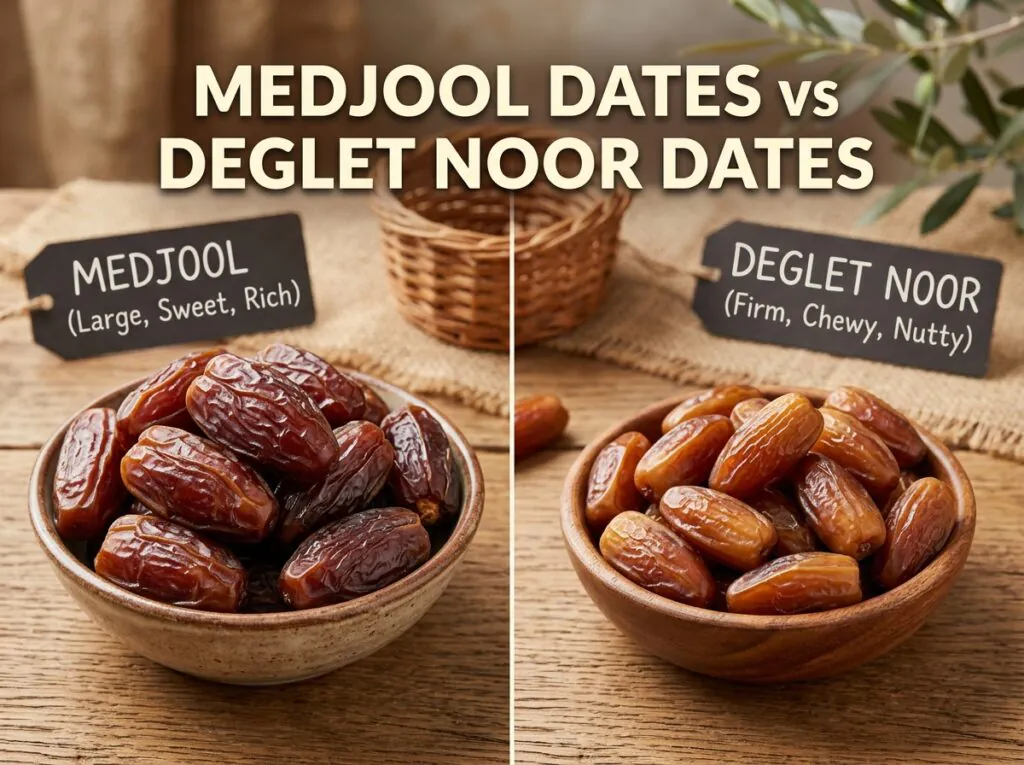
1. Physical Characteristics: Size, Color, and Appearance
At first glance, telling Medjool and Deglet Noor dates apart is relatively simple because their physical features differ significantly.
-
Medjool Dates: Often referred to as the “King of Dates,” Medjool dates are noticeably larger, sometimes up to double or triple the size of a standard Deglet Noor. They feature a deep mahogany to dark brown skin with natural, wrinkled folds. Their skin is supple, slightly fibrous, and soft to the touch.
-
Deglet Noor Dates: Deglet Noor translates literally to “Date of Light” or “Translucent Date.” True to their name, they are smaller, slender, and oval-shaped with an amber, translucent golden-brown skin when held up to light. Their exterior is smooth and firm compared to the deeply creased Medjool.
2. Taste Profile: Caramel Richness vs. Subtle Nutty Sweetness
Flavor is where the distinction between these two date varieties becomes most apparent during tasting.
-
Medjool Dates (Rich & Richly Sweet): Medjool dates deliver an intense, butterscotch and caramel-like sweetness. They taste almost like a decadent natural candy, with deep notes of honey and cinnamon. Because of their high fructose content, their flavor profile feels immediate, bold, and indulgence-driven.
-
Deglet Noor Dates (Mild & Nutty): Deglet Noor dates present a much lighter, balanced sweetness with a signature nutty finish. Their flavor profile is less overwhelming than Medjool, featuring clean undertones often compared to brown sugar, toasted butter, or cashew.
3. Texture and Moisture Content
Texture plays a massive role in how dates perform both as standalone snacks and as recipe ingredients.
-
Medjool (Soft, Plump, and Jammy): Medjool dates are classified as a semi-soft date, but they skew heavily toward soft and melt-in-your-mouth tender. They have a thick, meaty pulp that is delightfully moist and sticky.
-
Deglet Noor (Firm, Chewy, and Dry): Deglet Noor dates are firmer and have a drier, semi-dry flesh. They retain a sturdy, satisfying chew without dissolving immediately on the tongue, which makes them far easier to chop neatly without turning into a sticky paste.
4. Best Culinary Uses: Picking the Right Date for the Job
Because their moisture levels and structural firmess vary so drastically, each variety excels in different kitchen applications.
When to Choose Medjool Dates:
-
Raw Snacking & Stuffing: Thanks to their large size and hollowed-out centers when pitted, Medjools are the ultimate candidate for stuffing with goat cheese, walnuts, blue cheese, or peanut butter.
-
Smoothies & Shakes: Their soft texture allows them to blend effortlessly into milk, plant milks, or green smoothies without leaving gritty pieces behind.
-
No-Bake Energy Balls: The natural stickiness of Medjool dates acts as a superior binder for oat-and-nut energy bites, raw vegan crusts, and fudge bases.
When to Choose Deglet Noor Dates:
-
Precision Baking: Because Deglet Noor dates hold their shape exceptionally well under heat, they are the gold standard for fruitcakes, scones, cookies, and breads.
-
Dicing for Salads & Granola: Their firm texture makes them easy to slice cleanly into small, uniform cubes that disperse evenly throughout warm oatmeal, grain bowls, and green salads.
-
Commercially Diced Date Production: Industrial food manufacturing heavily favors Deglet Noor for pre-packaged chopped dates due to their lower moisture, preventing the pieces from clumping into a single block.
5. Nutritional Breakdown: How Do They Compare?
Nutritionally, both varieties are powerhouses of natural minerals and fiber, but subtle nuances exist.
| Nutritional Component | Medjool Dates | Deglet Noor Dates |
| Calorie Count | Slightly higher per fruit (due to size) | Lower per fruit, comparable per 100g |
| Fiber Content | High (Supports smooth digestion) | Slightly higher insoluble fiber ratio |
| Sugar Profile | Higher fructose (Softer, sweeter) | Balanced glucose & sucrose |
| Key Minerals | Rich in Potassium, Copper, Magnesium | Rich in Potassium, Vitamin B6, Iron |
Both varieties offer a low to moderate glycemic index when consumed in realistic serving sizes, thanks to their dietary fiber slowing down carbohydrate absorption into the bloodstream.
6. Storage and Shelf Life
-
Deglet Noor: Due to their lower moisture content, Deglet Noor dates boast a longer, more stable shelf life. They can sit at room temperature in a sealed container for months without losing their structural integrity or growing mold.
-
Medjool: Because Medjool dates carry more natural moisture, they benefit from cold storage. Storing them in the refrigerator preserves their plump, jammy quality, while freezing them extends their shelf life up to a full year without changing their texture.
Conclusion: Which Date Should You Choose?
When evaluating Medjool dates vs Deglet Noor dates, there is no single winner—only the right date for your specific need. If you want a soft, luxurious, caramel-like fruit for fresh snacking, smoothies, or raw desserts, Medjool is unmatched. If you require a firm, easy-to-chop, subtly sweet date for baking, cooking, or trail mixes, Deglet Noor is your ideal choice.
At Sahara Food EU, we supply both premium organic Medjool and Deglet Noor dates to businesses, distributors, and food producers across the European continent. Explore our wholesale selection today to get the finest Mediterranean dates delivered directly to your commercial operations.