
When searching for a healthier alternative to refined white sugar, the choice frequently comes down to an organic date powder vs coconut sugar comparison to see which natural sweetener fits best into a wholesome lifestyle. Both options have surged in popularity across Europe as health-conscious consumers and bakeries look to clean up their ingredient lists.
While both options are derived from whole plant sources, they possess distinct nutritional structures, flavor profiles, and functional properties in the kitchen. For those looking for premium natural sweeteners, evaluating options like Organic Date Powder alongside other plant-based sugars reveals how each unique ingredient impacts everyday health and culinary outcomes.
The Core Difference: Whole Food vs. Processed Nectar
To truly understand how these sweeteners match up, it helps to look at exactly how they are made. This fundamental difference dictates how they behave in your body and your recipes.
What is Organic Date Powder?
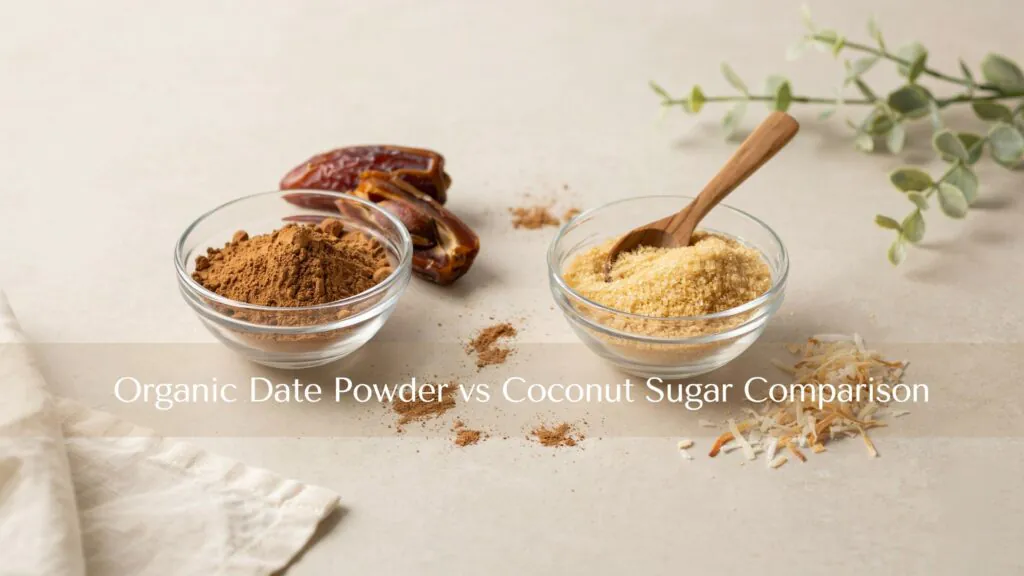
Organic date powder is not actually “sugar” in the traditional sense; it is a whole food. It is produced by taking premium organic dates, dehydrating them completely, and grinding them into a fine, free-flowing powder. Because the process avoids liquid extraction, filtering, or chemical manipulation, every single nutrient, fiber molecule, and antioxidant naturally present in the original fruit remains entirely intact in the final product.
What is Coconut Sugar?
Coconut sugar, on the other hand, is a granulated sugar derived from the liquid sap of the coconut palm tree’s flower buds. Farmers cut the bud to collect the watery sap, which is then heated over a large vat until most of the water evaporates. What remains is a thick syrup that cools and crystallizes into the familiar brown granules. While it is significantly less processed than white table sugar, it is still an isolated sugar crystalline rather than a ground whole food.
Nutritional Showdown: Fiber, Minerals, and Glycemic Impact
When evaluating their nutritional profiles, both sweeteners easily outperform highly processed white sugar, but one holds a clear edge regarding structural nutrients.
The Fiber Advantage
The presence of dietary fiber is where date powder truly stands apart from coconut sugar. Because it consists of the entire dried fruit, date powder contains substantial amounts of both soluble and insoluble fiber. Fiber acts as a natural brake system for your digestion, slowing down the absorption of fructose and glucose into your bloodstream. Coconut sugar contains a small amount of a soluble fiber called inulin, but it lacks the dense, fibrous matrix found in whole ground dates.
Glycemic Index (GI)
-
Coconut Sugar: Carries a Glycemic Index rating of roughly 35 to 54. This puts it in the low-to-medium GI category, meaning it causes a more gradual rise in blood sugar than standard sucrose.
-
Organic Date Powder: Generally ranks even lower on the functional glycemic impact spectrum. Even though dates are naturally sweet, the high concentration of intact fruit fiber prevents sharp insulin spikes, providing stable, long-lasting energy.
Micronutrients and Antioxidants
Both options supply the body with trace minerals, but their compositions differ:
-
Date Powder: Is highly dense in potassium, magnesium, iron, and copper. It also ranks incredibly high on the ORAC index (Oxygen Radical Absorbance Capacity) because dates are naturally packed with polyphenols and carotenoids that combat cellular oxidative stress.
-
Coconut Sugar: Offers a respectable mineral profile, including zinc, iron, calcium, and potassium, alongside short-chain fatty acids, though it contains fewer cell-protecting antioxidants than whole fruit powder.
Culinary Performance: How They Act in Baking and Cooking
A sweetener can be incredibly healthy, but it also needs to perform well in the kitchen. This is where their physical properties alter your cooking results.
Moisture and Solubility
This is the most critical distinction for bakers. Coconut sugar is highly soluble. Because it consists of crystals, it melts, dissolves, and liquidizes when exposed to heat or fluids. You can easily stir it into coffee, dissolve it into syrups, or cream it with butter for traditional cookie dough.
Date powder does not dissolve in water. Because it is made of finely ground fruit particles and insoluble plant fibers, it absorbs moisture rather than dissolving into it. If you try to stir it into an iced drink, it will eventually settle at the bottom.
Baking Adaptations
-
Using Coconut Sugar: Can generally be swapped with white or brown sugar at a strict 1:1 ratio. It provides a warm, molasses-like crunch to cookies and a beautiful brown color to cakes.
-
Using Date Powder: Works beautifully in cakes, muffins, bread, and brownies where moisture retention is desired. However, because it absorbs liquids, you may need to slightly increase the fluid content (such as water, milk, or oil) in your recipe to prevent the final product from turning out too dry. It is also excellent for dusting over oatmeal or blending smoothly into morning smoothies.
Flavor Profile: Caramel vs. Fruity Richness
The taste impact on your food depends entirely on what notes you want to emphasize.
-
Coconut Sugar: Tastes very similar to traditional brown sugar. It features deep, earthy notes of caramel and butterscotch. Despite its origin, it tastes nothing like coconut, making it a highly neutral swap for general recipes.
-
Organic Date Powder: Carries the distinct, rich, jammy sweetness of whole Khajoor. It injects a deep, complex fruitiness alongside hints of honey and caramel, which adds an incredible layer of flavor depth to spiced desserts, chocolate dishes, and savory sauces.
Summary Comparison Table
| Feature | Organic Date Powder | Coconut Sugar |
| Source Component | Whole dried date fruit | Coconut palm tree flower sap |
| Processing Level | Minimal (Dehydrated & ground) | Medium (Evaporated & crystallized) |
| Solubility | Low (Absorbs moisture, doesn’t dissolve) | High (Melts and dissolves easily) |
| Dietary Fiber | Exceptionally high | Minimal (Contains some inulin) |
| Flavor Profile | Rich fruitiness, honey, caramel | Earthy caramel, similar to brown sugar |
| Best Used For | Smoothies, muffins, thick bakes, oatmeal | Coffee, teas, crispy cookies, general baking |
Conclusion: Which One Should You Choose?
In this comparison, the right choice ultimately depends on your specific culinary and dietary goals. If your priority is finding a direct, hassle-free 1:1 substitute for cane sugar that dissolves perfectly in hot beverages and creates crispy textures in delicate pastries, coconut sugar is a reliable asset.
However, if your primary goal is maximizing nutritional density, adding whole-food fiber to your diet, and avoiding isolated sugars altogether, organic date powder is the superior option. It allows you to sweeten your food using raw, unadulterated fruit, making it an ideal choice for clean eating.
At Sahara Food EU, we ensure our organic date powder is processed gently to preserve every ounce of fiber and flavor, giving your kitchen the purest natural alternative possible.